search this blog

Showing posts with label ancient DNA. Show all posts

Saturday, September 6, 2025

Early Slavs from Tribal Period Poland


A paper dealing with the origin of Slavic speakers, titled Ancient DNA connects large-scale migration with the spread of Slavs, was just published at Nature by Gretzinger et al. (see here).

The dataset from the paper includes eight fascinating ancient samples from Gródek upon the Bug River in Southeastern Poland. These individuals are dated to the so called Tribal Period (8th –9th centuries), and, as far as I know, they represent the earliest Slavic speakers in the ancient DNA record.

The really interesting thing about these early Slavs is that they already show some Germanic and other Western European-related ancestries.

In the Principal Component Analysis (PCA) plots below, three of them cluster near present-day Ukrainians, while the rest are shifted towards present-day Northwestern, Western and Southern Europeans. The plots were produced with the excellent Vahaduo G25 Global Views tool using the data here.


These results aren't exactly shocking, because the people who preceded the early Slavs in the Gródek region were Scandinavian-like and associated with the Wielbark archeological culture. In other words, they were probably Goths who also had significant contacts with the Roman Empire.

However, it's not a given that the ancestors of the Tribal Period Slavs mixed with local Goths. It's also possible that they brought the western admixture, or at least some of it, from the Slavic homeland, wherever that may have been.

That's because the early Slavs who migrated deep into what is now Russia also showed Western European-related admixture. This is what Gretzinger et al. say on page 74 of their supplementary info (emphasis is mine):

The only deviation from this pattern is observed for ancient samples from the Russian Volga-Oka region, where we measure higher genetic affinity between present-day Southern/Western Europeans and the SP population compared to the pre-SP population (Fig. S17). This agrees with the pattern observed in PCA and ADMIXTURE that, in contrast to the Northwestern Balkan, Eastern Germany, and Poland-Northwestern Ukraine, the arrival of Slavic-associated culture in Northwestern Russia was associated with a shift in PCA space to the West, a decrease of BAL [Baltic] ancestry, and the introduction of Western European ancestries such as CNE [Continental North European] and CWE [Continental Western European].

Thus, it's highly plausible that the Tribal Period Slavs from Gródek were very similar, perhaps even practically identical, to the proto-Slavs who lived in the original Slavic homeland. Hopefully we won't have to wait too long to discover whether that's true or not. More Migration period and Slavic period samples from the border regions of Belarus, Poland and Ukraine are needed to sort that out.

On the other hand, most of the post-1000 CE individuals from Gródek are shifted closer to present-day Balts. This is probably due to admixture from nearby Baltic-speaking populations. At the time, Baltic speakers still occupied much of northern and eastern Poland.

I'm still going through the Gretzinger et al. paper and I'll probably have a lot more to say about it in the near future.

However, unfortunately, I've already spotted a silly mistake in the supplementary info that will probably have some very annoying consequences for us on this blog. On page 109 the authors make the false claim that South Asian ancestry is present in a wide range of ancient Eastern European and Central Asian populations from the Bronze Age to the Scythian period.

Furthermore, Sycthian groups from Ukraine show varying fractions of South Asian ancestry (between 5% and 12%), a component present in many ancient individuals from Moldova (e.g. Moldova_IA, Moldova_LBA and Moldova_MBA), Ukraine (Ukraine_Alexandria_MBA and Ukraine_BA_Catacomb.SG), Western Russia (e.g. Russia_EarlySarmatian.SG, Russia_MLBA_Potapovka, or Russia_MLBA_Sintashta) and the Caucasus (Russia_Caucasus_LBA_Dolmen and Russia_North_Caucasus_MBA) but (nearly) absent in the SP genomes from Central and East-Central Europe (<5%) (Fig. S42b).

All ancient and present-day South Asian populations carry what is commonly known as Ancestral South Indian (ASI) ancestry, while all of the above mentioned ancient groups lack it. Ergo, it's impossible for these ancients to have actual South Asian ancestry.

What happened is that Gretzinger et al. created a genetic component in ADMIXTURE based on present-day South Asians. However, South Asians today have very complex ancestry from several different sources, including early pastoralists from the North-Pontic steppe in Eastern Europe and early farmers from Central Asia and what is now Iran. As a result, the groups that share significant amounts of alleles with South Asians via these sources also show so called South Asian ancestry in the Gretzinger et al. analysis.

Unless this problem is corrected we're likely to see some nutjobs online using this paper to claim all sorts of nonsense about the origins of ancient Eastern Europeans and Central Asians, especially the Sintashta people and Scythians.

See also...

High-resolution stuff

Leo Speidel & Pontus Skoglund

Friday, November 10, 2023

Wielbark Goths were overwhelmingly of Scandinavian origin


When used properly, Principal Component Analysis (PCA) is an extraordinarily powerful tool and one of the best ways to study fine-scale genetic substructures within Europe.

The PCA plot below is based on Global25 data and focuses on the genetic relationship between Wielbark Goths and Medieval Poles, including from the Viking Age, in the context of present-day European genetic variation.


I'd say that it's a wonderfully self-explanatory plot, but here are some key observations:

- the Wielbark Goths (Poland_Wielbark_IA) and Medieval Poles (Poland_Middle_Ages) are two distinct populations

- moreover, the Wielbark Goths form a relatively compact Scandinavian-related cluster and must surely represent a homogenous population overwhelmingly of Scandinavian origin

- on the other hand, the Medieval Poles form a more extensive and heterogeneous cluster that overlaps with present-day groups all the way from Central Europe to the East Baltic, and that's because they are likely to be in large part of mixed origin

- I know for a fact that at least some of these early Poles harbor recent admixture, because their burials are similar to those of Vikings and their haplotypes have been shown to be partly of Scandinavian origin (see here)

- one of the Wielbark females is an obvious genetic outlier (Poland_Wielbark_IA_outlier), and basically looks like a first generation mixture between a Goth and a Balt.

Please note that the PCA is only based on relatively high quality genomes, so as not to confuse the picture with spurious results and noise. Also, all outliers with potentially significant ancestry from outside of Central, Eastern and Northern Europe were removed from the analysis. The relevant datasheet is available here.

However, sanity checks are always important when studying complex phenomenon like fine-scale genetic ancestry. To that end I've prepared a graph based on f3-statistics of the form f3(X,Cameroon_SMA,Estonia_BA)/(X,Cameroon_SMA,Ireland_Megalithic), that reproduces the key features of my PCA. The relevant datasheet is available here.

Polish groups from the Middle Ages are marked with the MA suffix, while the Iron Age Wielbark Goths are marked with the IA suffix.

If you're wondering why I plotted the f3-statistics that I did, take a look at this (all groups largely of Scandinavian origin are emboldened):

f3(X,Estonia_BA,Cameroon_SMA)
Poland_Legowo_MA 0.226406
Poland_Ostrow_Lednicki_MA 0.225996
Poland_Plonsk_MA 0.225017
Poland_Trzciniec_Culture 0.224215
Poland_Lad_MA 0.224142
Poland_Viking 0.223838
Poland_Niemcza_MA 0.223659
Poland_Weklice_IA 0.223549
Poland_Kowalewko_IA 0.222584
Poland_Pruszcz_Gdanski_IA 0.222324
Sweden_Viking 0.222091
Russia_Viking 0.222042
Poland_Maslomecz_IA 0.221914
Norway_Viking 0.221825
Denmark_EarlyViking 0.221257
Denmark_Viking 0.221174
England_Viking 0.220979

f3(X,Ireland_Megalithic,Cameroon_SMA)
Poland_Maslomecz_IA 0.219816
Poland_Weklice_IA 0.219501
Denmark_Viking 0.2192
Poland_Kowalewko_IA 0.219176
Poland_Ostrow_Lednicki_MA 0.218916
Norway_Viking 0.218854
Poland_Pruszcz_Gdanski_IA 0.218684
Sweden_Viking 0.218626
Denmark_EarlyViking 0.218529
England_Viking 0.218308
Russia_Viking 0.217999
Poland_Viking 0.217914
Poland_Plonsk_MA 0.217756
Poland_Lad_MA 0.217719
Poland_Legowo_MA 0.21765
Poland_Niemcza_MA 0.217001
Poland_Trzciniec_Culture 0.216551

Interestingly, the Middle Bronze Age samples associated with the Trzciniec Culture (Poland_Trzciniec_Culture) show a closer genetic relationship to Medieval Poles than to Wielbark Goths or Northwestern Europeans. This is indeed the case both in terms of genome-wide and uniparental markers, including some very specific lineages under Y-chromosome haplogroup R1a.

But that's a much more complex issue that I'll leave for another time. So please stay tuned.

See also...

Slavs have little, if any, Scytho-Sarmatian ancestry

Tuesday, January 11, 2022

Population genetics is a state of mind


Years of blogging about population genetics has seriously eroded my faith in the peer review process.

During the past decade I've witnessed an inordinate amount of crap published in basically all of the major science journals. Often the work is misguided in some way, sometimes even quite strange, and occasionally outright wrong.

Back in 2014, a team of scientists from the UK published a paper in Science emphatically titled A Genetic Atlas of Human Admixture History. These people were Garrett Hellenthal, George B. J. Busby, Gavin Band, James F. Wilson, Cristian Capelli, Daniel Falush, and Simon Myers. See here.

The thing that really sticks out for me in this paper is Figure 3, which shows the present-day Polish population as largely a mixture between Northern European- and Turkish-related ancestries. Incredibly, the Turkish-related ratio appears to be about 25% and dated to 438 CE.

This is not just inexplicable, but utterly wrong. It's a result that is impossible to reproduce with any standard population genetics methods.

In fact, in terms of deep ancient ancestry, present-day Poles are very similar to present-day Scandinavians, and even to Viking Age, Iron Age and Bronze Age Scandinavians. This is easy to demonstrate, for instance, with f4-statistics, in part based on samples from the Hellenthal et al. paper.

Chimp Yamnaya_Samara Swedish_modern Polish_modern -0.000311 -1.574
Chimp Yamnaya_Samara Ollsjo_Bronze_Age Polish_modern -0.000044 -0.152
Chimp Yamnaya_Samara Sealand_Iron_Age Polish_modern -0.000072 -0.293
Chimp Yamnaya_Samara Sealand_Viking_Age Polish_modern 0.000078 0.525
Chimp Yamnaya_Samara Gotland_Viking_Age Polish_modern -0.000141 -1.322

Chimp Barcin_N Swedish_modern Polish_modern -0.000318 -1.662
Chimp Barcin_N Ollsjo_Bronze_Age Polish_modern 0.000216 0.798
Chimp Barcin_N Sealand_Iron_Age Polish_modern -0.000023 -0.104
Chimp Barcin_N Sealand_Viking_Age Polish_modern -0.000186 -1.310
Chimp Barcin_N Gotland_Viking_Age Polish_modern 0.000083 0.788

Chimp Karelia_HG Swedish_modern Polish_modern -0.000134 -0.540
Chimp Karelia_HG Ollsjo_Bronze_Age Polish_modern 0.000056 0.162
Chimp Karelia_HG Sealand_Iron_Age Polish_modern 0.000047 0.153
Chimp Karelia_HG Sealand_Viking_Age Polish_modern 0.000424 2.241
Chimp Karelia_HG Gotland_Viking_Age Polish_modern 0.000134 0.959

Simply put, if Poles have ~25% ancestry from a Turkish-related source, then so do Swedes, Norwegians and basically all other Northern Europeans going back hundreds and even thousands of years. This is obviously not the case, and it's also not what Hellenthal et al. claimed anyway.

A year later, a team of scientists that again included Garrett Hellenthal, George B. J. Busby, James F. Wilson, Cristian Capelli and Simon Myers, published another, similar paper in Current Biology. And guess what? This paper also claimed that present-day Poles had Turkish-related ancestry, but this time dating to a somewhat later period. See Busby et al. 2015 Figure 4.C here.

I've got most of the samples from that paper, so I can analyze them myself, and I think I know what the problem is. Basically, the Turks are mixed. So what appears to have happened is that Busby et al. got things backwards.

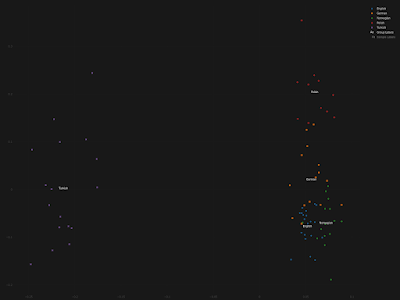
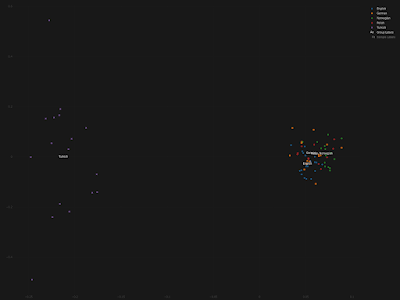
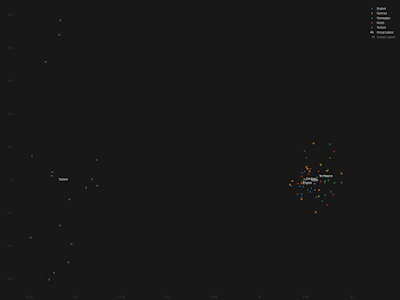
Below are three plots from a Principal Component Analysis (PCA) largely based on data from Busby et al., featuring samples from England, Germany, Norway, Poland and Turkey. The first plot is based on dimensions 1 and 2, the second plot on dimensions 1 and 3, and the third plot on dimensions 1 and 4. The relevant data file is available here.

Note that the Europeans are more or less symmetrically related to the Turks, which means none of these European populations has significantly more Turkish-related ancestry than the others. Indeed, it's the Turks who show more variation in the first (horizontal) dimension, suggesting that they might have variable levels of European ancestry.


I chose the aforementioned papers to make my point here because they made quite an impression on me. In other words, they really pissed me off.

For the sake of completeness, I'm now going to try and get in touch with the authors and ask them how on earth they managed to make these Poles Turkish-related, and also why they never corrected their mistake.

See also...

Don't believe everything you read in peer reviewed papers

Wednesday, July 17, 2019

Viking invasion at bioRxiv


A new preprint featuring hundreds of Viking Age genomes has appeared at bioRxiv [LINK]. Titled Population genomics of the Viking world, it looks like a solid effort overall, although I'm skeptical about its conclusions. I might elaborate on that in the comments below, but I'll have a lot more to say on the topic if and when I get to check out the ancient genomes with my own tools. Details about the new samples, including their Y-chromosome haplogroup assignments, are available here. Below is the abstract, emphasis is mine:

The Viking maritime expansion from Scandinavia (Denmark, Norway, and Sweden) marks one of the swiftest and most far-flung cultural transformations in global history. During this time (c. 750 to 1050 CE), the Vikings reached most of western Eurasia, Greenland, and North America, and left a cultural legacy that persists till today. To understand the genetic structure and influence of the Viking expansion, we sequenced the genomes of 442 ancient humans from across Europe and Greenland ranging from the Bronze Age (c. 2400 BC) to the early Modern period (c. 1600 CE), with particular emphasis on the Viking Age. We find that the period preceding the Viking Age was accompanied by foreign gene flow into Scandinavia from the south and east: spreading from Denmark and eastern Sweden to the rest of Scandinavia. Despite the close linguistic similarities of modern Scandinavian languages, we observe genetic structure within Scandinavia, suggesting that regional population differences were already present 1,000 years ago. We find evidence for a majority of Danish Viking presence in England, Swedish Viking presence in the Baltic, and Norwegian Viking presence in Ireland, Iceland, and Greenland. Additionally, we see substantial foreign European ancestry entering Scandinavia during the Viking Age. We also find that several of the members of the only archaeologically well-attested Viking expedition were close family members. By comparing Viking Scandinavian genomes with present-day Scandinavian genomes, we find that pigmentation-associated loci have undergone strong population differentiation during the last millennia. Finally, we are able to trace the allele frequency dynamics of positively selected loci with unprecedented detail, including the lactase persistence allele and various alleles associated with the immune response. We conclude that the Viking diaspora was characterized by substantial foreign engagement: distinct Viking populations influenced the genomic makeup of different regions of Europe, while Scandinavia also experienced increased contact with the rest of the continent.

Margaryan et al., Population genomics of the Viking world, bioRxiv, posted July 17, 2019, doi: https://doi.org/10.1101/703405

See also...

They came, they saw, and they mixed

Who were the people of the Nordic Bronze Age?

Asiatic East Germanics