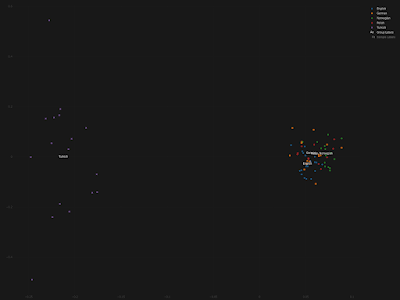
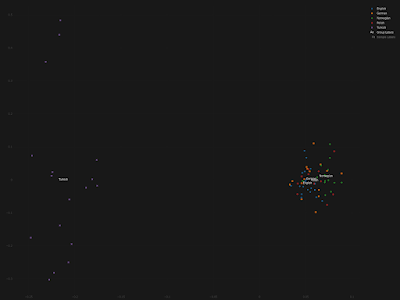
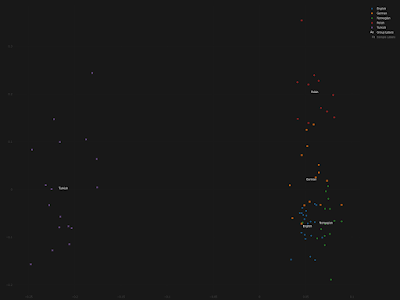
Chimp Yamnaya_Samara Swedish_modern Polish_modern -0.000311 -1.574 Chimp Yamnaya_Samara Ollsjo_Bronze_Age Polish_modern -0.000044 -0.152 Chimp Yamnaya_Samara Sealand_Iron_Age Polish_modern -0.000072 -0.293 Chimp Yamnaya_Samara Sealand_Viking_Age Polish_modern 0.000078 0.525 Chimp Yamnaya_Samara Gotland_Viking_Age Polish_modern -0.000141 -1.322 Chimp Barcin_N Swedish_modern Polish_modern -0.000318 -1.662 Chimp Barcin_N Ollsjo_Bronze_Age Polish_modern 0.000216 0.798 Chimp Barcin_N Sealand_Iron_Age Polish_modern -0.000023 -0.104 Chimp Barcin_N Sealand_Viking_Age Polish_modern -0.000186 -1.310 Chimp Barcin_N Gotland_Viking_Age Polish_modern 0.000083 0.788 Chimp Karelia_HG Swedish_modern Polish_modern -0.000134 -0.540 Chimp Karelia_HG Ollsjo_Bronze_Age Polish_modern 0.000056 0.162 Chimp Karelia_HG Sealand_Iron_Age Polish_modern 0.000047 0.153 Chimp Karelia_HG Sealand_Viking_Age Polish_modern 0.000424 2.241 Chimp Karelia_HG Gotland_Viking_Age Polish_modern 0.000134 0.959Simply put, if Poles have ~25% ancestry from a Turkish-related source, then so do Swedes, Norwegians and basically all other Northern Europeans going back hundreds and even thousands of years. This is obviously not the case, and it's also not what Hellenthal et al. claimed anyway. A year later, a team of scientists that again included Garrett Hellenthal, George B. J. Busby, James F. Wilson, Cristian Capelli and Simon Myers, published another, similar paper in Current Biology. And guess what? This paper also claimed that present-day Poles had Turkish-related ancestry, but this time dating to a somewhat later period. See Busby et al. 2015 Figure 4.C here. I've got most of the samples from that paper, so I can analyze them myself, and I think I know what the problem is. Basically, the Turks are mixed. So what appears to have happened is that Busby et al. got things backwards. Below are three plots from a Principal Component Analysis (PCA) largely based on data from Busby et al., featuring samples from England, Germany, Norway, Poland and Turkey. The first plot is based on dimensions 1 and 2, the second plot on dimensions 1 and 3, and the third plot on dimensions 1 and 4. The relevant data file is available here. Note that the Europeans are more or less symmetrically related to the Turks, which means none of these European populations has significantly more Turkish-related ancestry than the others. Indeed, it's the Turks who show more variation in the first (horizontal) dimension, suggesting that they might have variable levels of European ancestry. I chose the aforementioned papers to make my point here because they made quite an impression on me. In other words, they really pissed me off. For the sake of completeness, I'm now going to try and get in touch with the authors and ask them how on earth they managed to make these Poles Turkish-related, and also why they never corrected their mistake. See also... Don't believe everything you read in peer reviewed papers
Focusing on Polish and European population genetics and modern physical anthropology.
search this blog
Showing posts with label ancestry. Show all posts
Tuesday, January 11, 2022
Population genetics is a state of mind
Years of blogging about population genetics has seriously eroded my faith in the peer review process.
During the past decade I've witnessed an inordinate amount of crap published in basically all of the major science journals. Often the work is misguided in some way, sometimes even quite strange, and occasionally outright wrong.
Back in 2014, a team of scientists from the UK published a paper in Science emphatically titled A Genetic Atlas of Human
Admixture History. These people were Garrett Hellenthal, George B. J. Busby, Gavin Band, James F. Wilson, Cristian Capelli, Daniel Falush, and Simon Myers. See here.
The thing that really sticks out for me in this paper is Figure 3, which shows the present-day Polish population as largely a mixture between Northern European- and Turkish-related ancestries. Incredibly, the Turkish-related ratio appears to be about 25% and dated to 438 CE.
This is not just inexplicable, but utterly wrong. It's a result that is impossible to reproduce with any standard population genetics methods.
In fact, in terms of deep ancient ancestry, present-day Poles are very similar to present-day Scandinavians, and even to Viking Age, Iron Age and Bronze Age Scandinavians. This is easy to demonstrate, for instance, with f4-statistics, in part based on samples from the Hellenthal et al. paper.
Monday, July 13, 2020
Don't believe everything you read in peer reviewed papers
Case in point, here's a quote from a recent paper at the Journal of Human Genetics (emphasis is mine):
The Mordovian and Csango samples have a moderate to slight orientation toward the Central-Asian and Siberian Turkic groups. This could suggest the more significant East Eurasian or Turkic ancestry of these populations, which should be further investigated. German samples are inhomogeneous, and some of the German samples also show this tendency, which can be the result of the recent 20th century Turkish immigration into Germany [42].Nope, these German samples don't show anything even remotely resembling recent Turkish ancestry. The authors of the paper, Ádám, V., Bánfai, Z., Maász, A. et al., should've been able to figure this out, even with the standard analyses that they ran on their dataset. Failing that, the peer reviewers at the Journal of Human Genetics should've noticed that the authors were confused. Moreover, if the authors and peer reviewers actually bothered to take a closer look at metadata for these samples, which were sourced from the Estonian Biocentre, they'd see that they're not even from Germany. In fact, they represent self-reported ethnic Germans from Russia. My own quick and dirty analysis of these individuals suggests that many of them harbor East Slavic and/or Volga Finnic ancestries. Indeed, only some of them can pass genetically for run of the mill Germans from Germany. The Principal Component Analysis (PCA) below is self-explanatory. It was run with the Vahaduo Custom PCA tools freely available here. The relevant PCA datasheet can be gotten here. That's not to say, of course, that some Germans don't have recent Turkish ancestry, because an increasing number of Germans nowadays do, nor that people with German heritage in Russia shouldn't identify as Germans, because that's entirely their choice. This blog post isn't about what it takes to be German, and this is not something that I ever want to discuss for obvious reasons. The point I'm making here is that the authors and peer reviewers of the said paper at the Journal of Human Genetics were sloppy and half-arsed in their approach. And, sadly, this isn't an isolated case in peer reviewed scientific literature dealing with human population genetics. I feel that the Estonian Biocentre is also partly to blame for this cock up, due to its somewhat peculiar sampling and labelling strategies. For instance, its scientists rely solely on self-reported identity to establish the ethnic origins of their samples, and they apparently never remove genetic outliers from their datasets or even try to identify them. Unfortunately, I fear that this relaxed approach will eventually lead to basic errors and even unusual conclusions in a number of so called peer reviewed papers. I first raised this issue with the Estonian Biocentre about five years ago, when I noticed that some of the supposedly Polish individuals in its dataset were genetically more similar to various groups from northern Russia than to Poles from Poland. These individuals also showed significant Siberian ancestry, which was very unusual indeed. Where the hell did the Estonian Biocentre find Poles who resembled people from near the Arctic circle, you might ask? Apparently in Estonia. OK, I can imagine that sampling ethnic Poles from Estonia may have been easier for the Estonian Biocentre than sampling Poles from Poland. And Estonian Poles certainly make for interesting and useful data points. However, as you can see in the PCA below, some of these samples (labeled Polish_Estonia by me) aren't representative of the native Polish population, and yet the Estonian Biocentre not only lumps them with their Poles from Poland sample set, but even labels them with the word "Poland". The relevant PCA datasheet can be gotten here. But, based on my communications with some of the scientists at the Estonian Biocentre, including head honcho Mait Mestpalu, it seems that nothing will ever change there in regards to this issue. Who knows, perhaps some day we'll see a paper based on Estonian Biocentre data in the Journal of Human Genetics claiming that Poles originated near the Arctic circle? I wouldn't be shocked if that actually happened. Citation... Ádám, V., Bánfai, Z., Maász, A. et al. Investigating the genetic characteristics of the Csangos, a traditionally Hungarian speaking ethnic group residing in Romania. J Hum Genet (2020). https://doi.org/10.1038/s10038-020-0799-6 See also... Like three peas in a pod
Labels:
admixture,
ancestry,
Estonian Biocentre,
ethnicity,
Europe,
European,
genetic,
genetic ancestry,
German,
Germanic,
Germany,
homogeneous,
Mait Metspalu,
mixed,
Poland,
Polish,
Russia,
self-identity,
Slavic
Subscribe to:
Posts (Atom)